


For anyone who makes the decision to carry a firearm for self-defense, this question is often one of the first questions they ask when they start to carry. It can be framed as a debate between preparedness and safety, and the answer you choose has profound implications for your ability to protect yourself and your loved ones. While carrying on an empty chamber might feel like a practical and responsible choice, the overwhelming consensus from self-defense experts, firearms instructors, law enforcement, and seasoned carriers is clear: for defensive purposes, you should carry with a round in the chamber.
This guide will break down the myths, the mechanics, and the tactical realities to show you not only that carrying with one in the chamber is safe, but why it’s the most responsible choice for anyone serious about personal protection.
The Great Debate
The concern is understandable. A gun is a tool that must be treated with respect, and the idea of carrying it in a state where it is immediately ready to fire can be intimidating for new and experienced gun owners alike. Sometimes new owners may feel it could ‘go off at any moment’ while they are carrying it next to their body. Unless you have confidence in your gun, carrying it with one in the chamber can be an unnerving experience.
This method brings up questions that you should have answers to before you can feel comfortable carrying one in the chamber:
- What if I drop the gun?
- What if a child gets hold of it?
- Could my clothing snag the trigger?
- Isn’t an empty chamber the most reliable safety?
These questions come from a place of responsibility. However, answering them requires looking past initial feelings and examining the actual circumstances surrounding concealed carry, the design of modern firearms, and the brutal realities of a real self-defense encounter.
Time on Target: Does Racking the Slide Really Slow You Down?
The short answer is emphatically yes, and the time it costs is critical.
In a true defensive situation, you are, by definition, reacting to a threat. The aggressor typically has the initiative; they choose the time and place of the attack. You are already starting behind the curve.
A firearms instructor has put this to the test, timing the results on the range. The results showed that drawing and firing from a loaded chamber (even starting with the safety on) was, on average, about 0.5 seconds faster than drawing, racking the slide, and then firing.
In a world where a determined attacker can close a 21-foot gap in about 1.5 seconds, that half-second delay you impose on yourself by carrying with an empty chamber could become a lifetime: specifically, how much lifetime you have left. By carrying with an empty chamber, you are giving your attacker a free head start to close the distance, inflict harm, fire first, etc.
The Two-Hand Problem
More critical than the loss of time is the loss of capability. Racking the slide on a semi-automatic pistol is a two-handed operation if you want to do it quickly and reliably, and the desirability of both of those factors becomes literally invaluable in an actual self-defense situation. The core flaw in an empty-chamber strategy is the dangerous assumption that you will have both hands free when an attack occurs.
Consider these highly probable scenarios to see why this is not a theory you can hang your life on. As you are trying to draw, any of these can easily happen:
- Your support hand is busy fending off the attacker’s strikes.
- You are using your other hand to hold or push a child or loved one behind you.
- You’ve been knocked to the ground, and one arm is pinned beneath you.
- Your support hand has already been injured in the initial assault.
Needing to rack the slide instantly puts you at a catastrophic disadvantage, perhaps the final disadvantage of your life. While one-handed slide racking is a skill, doing it reliably is an advanced, difficult, and even worse, still significantly slower technique than racking with two hands, which is already slower than carrying with one in the chamber. Add on top of that the truth that it will become even more unreliable under extreme stress and adrenaline.
You can see why assuming you’ll have two free hands to make your gun ready is a gamble your life isn’t worth taking.
But this could be a moot point if carrying with one in the chamber is a dangerous thing to do. So let’s take a look at modern gun safeties.
How Modern Guns Are Engineered
The fear of a gun “just going off” is largely based on experiences with older, less sophisticated guns. Modern pistols are marvels of engineering, designed from the ground up to be carried safely with a round in the chamber.
Internal Safeties in Striker-Fired Pistols
The most popular concealed carry firearms today (like Glock, Smith & Wesson M&P, Springfield XD, and HK VP9) are striker-fired and feature multiple passive safeties that work in unison. These include:
- Trigger Safety: A lever on the face of the trigger that must be depressed for the trigger to move rearward.
- Firing Pin safety: A physical, spring-loaded block that prevents the firing pin from moving forward unless the trigger is fully pulled. This is the primary defense against the gun firing if dropped.
- Drop Safety: Additional internal mechanisms that ensure the sear does not move and release the striker if the gun is dropped or jarred.
For a modern, well-maintained firearm of this type to fire, the trigger must be fully pulled.
The Revolver’s Transfer Bar Safety
In the 19th century, some people carried revolvers with an empty chamber under the hammer because they lacked modern safeties. Dropping the gun could cause the hammer to strike the primer. This is no longer the case with safe revolver designs. Modern revolvers typically feature a transfer bar safety, a small metal piece that rises into place between the hammer and the firing pin only when the trigger is pulled. Without the trigger pull, there is no metal to transfer the force of the hammer to the bullet, making it perfectly safe to carry fully loaded.
The Crucial Role of a Quality Holster
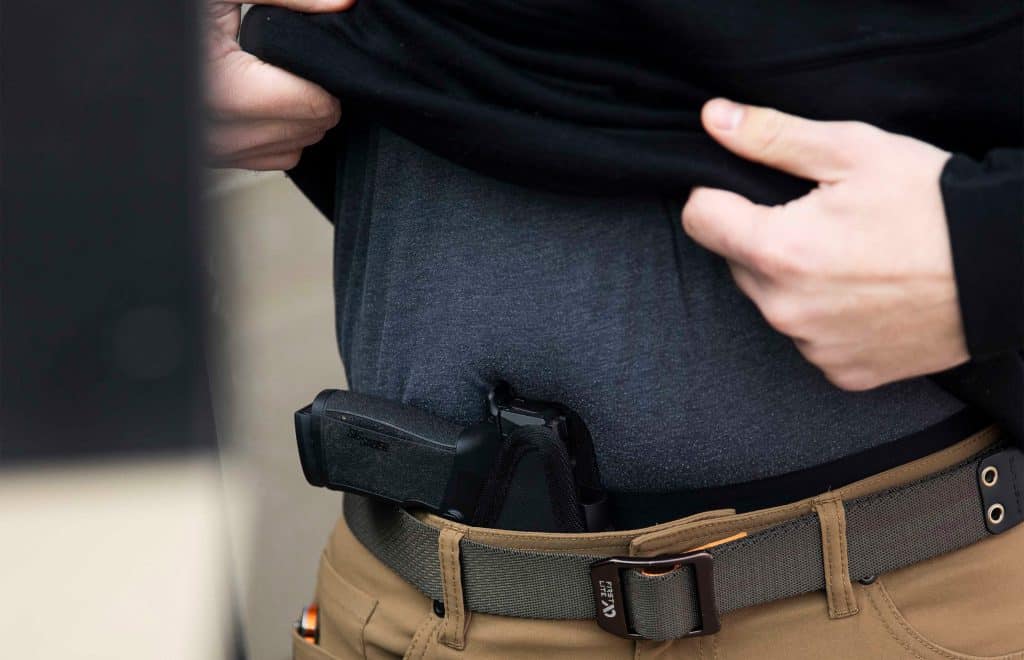
The single most important piece of safety equipment you will own is your holster. A modern firearm is safe; a modern gun from reliable brands such as Glock, Smith and Wesson Springfield, and more with internal safeties, in a quality holster can be trusted. The primary safety function of a holster is to completely cover the trigger guard, making it impossible for anything to manipulate the trigger until you deliberately draw the weapon.
Buy a quality holster made for your firearm model. This non-negotiable piece of gear is the key to carrying with a chambered round confidently and safely.
“Israeli Carry”: History vs. Modern Reality
Proponents of carrying on an empty chamber often point to the “Israeli Carry” method. However, its historical context is critical. In its early days, the Israeli military had a mismatched collection of various pistols with different safety systems. To standardize training across different pistols and ensure safety with these older guns, they mandated carrying with an empty chamber.
This context does not apply to a modern citizen carrying a quality, drop-safe pistol. Furthermore, Israeli soldiers drilled the act of racking the slide upon the draw thousands of times to achieve proficiency and reduce this issue, which is a level of training most civilian carriers do not undertake.
Building Safety and Confidence Through Training
Ultimately, true gun safety doesn’t come from an empty chamber; it comes from you. It’s about training, discipline, and confidence.
If you are new to carrying or hesitant about a loaded chamber, the solution isn’t to handicap your defensive tool.
The solution is to invest in yourself:
- Seek Professional Training: A qualified instructor can teach you the fundamentals of a safe and efficient draw stroke, trigger discipline, and muzzle awareness.
- Practice with Dummy Rounds: To build confidence, carry your gun in its holster at home, with a dummy round or snap cap in the chamber. After a few days, you will see that the trigger has not been pulled accidentally, reinforcing trust in your gear and handling. (Take the utmost care not to confuse live and dummy rounds!)
- Master the Four Rules: Live by the universal rules of firearm safety until they are second nature.
The Verdict
The question of whether to carry with one in the chamber is not actually about “safe vs. unsafe.” It is about “ready vs. unready.” A modern firearm with internal safeties, in a quality holster, is safe.
By choosing to carry with an empty chamber, you are making a conscious decision to be slower and less capable in the one moment where speed and reliability matter most. The most responsible action you can take is to accept the full duty of a concealed carrier: select the right equipment, train, and carry your firearm in a state of immediate readiness. Hopefully a situation in which you need your gun never occurs, but if it does, you will need that gun on target and ready to fire as fast as you can manage it, and if you get through the experience, you can expect you’ll be extremely happy you carried with one in the chamber.
Your Readiness Depends on the Right Holster
Making the decision to carry with one in the chamber is a commitment to your personal safety and the safety of those in your care. The final step is choosing the holster that makes this commitment practical and comfortable for everyday life. An uncomfortable or unsafe holster is a common reason that your life-saving firearm gets left uselessly at home.
At Sticky Holsters, we believe safety and comfort can coincide.
Uncompromising Safety: A quality holster must completely protect the trigger guard. Our holsters are meticulously designed to do just that, creating a secure pocket for your firearm. The innovative, non-slip material of a Sticky Holster clings to your waistband or pocket, ensuring your firearm and its protected trigger stay exactly where you put them, draw after draw.
All-Day Comfort: We eliminated the hard clips, sharp edges, and bulky shells that can make traditional holsters painful to wear. A Sticky Holster is lightweight and pliable, conforming to your body for a comfortable carry experience, whether you’re driving, walking, or sitting for hours. This focus on comfort ensures you’ll never have to make the choice between being prepared and being comfortable again.
Don’t let inadequate gear compromise your safety or your readiness. Carry with a round in the chamber confidently and comfortably.
Find the Perfect Sticky Holster for Your Gun Now!