

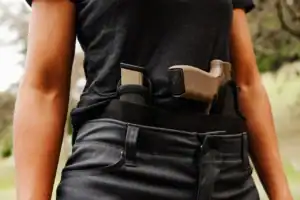

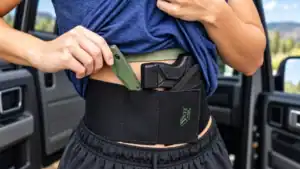
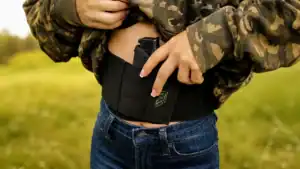

For responsible armed citizens, on-body carry is the gold standard. When it’s possible to do so, a quality firearm secured in a holster attached to your body provides the best balance of security, stability, and speed. But life doesn’t always conform to the ideal. Professional dress codes, athletic wear, body shape, or even just the heat of summer can make concealed, on-body carry impractical or impossible on any given day.
This is where off-body carry, typically using a purpose-built purse, sling bag, or briefcase, enters the picture. Effective off-body carry should be treated as a deliberate system that demands the same (if not a higher) level of discipline and the right equipment to be done safely, just as with on-body carry. This guide is designed to help you build that system, grounded in best practices for maintaining control, ensuring safety, and staying prepared.
The Real-World Pros and Cons
Choosing any carry method involves weighing trade-offs. Off-body carry offers unique advantages that solve many daily challenges, but these benefits come with equally unique responsibilities.
The Pros
- Complete Wardrobe Freedom: This is the most common reason carriers opt for an off-body setup. It allows you to remain armed regardless of your attire, from business suits to gym shorts.
- Enhanced Comfort: For those who spend long hours sitting, driving, or find on-body holsters to be uncomfortable, carrying in a bag can eliminate pressure points and discomfort. (Sticky Holsters were designed to alleviate discomfort and do so excellently, but if you’re sitting on a gun for 8 hours a day, well, there’s only so much your holster can do.)
- Ability to Carry a Larger Firearm: Off-body carry allows you to carry a larger, higher-capacity handgun than you might be able to conceal on your person, meaning you don’t have to make a compromise between concealment and your ideal choice of defensive tool.
- Convenience in Non-Permissive Environments: If you have to enter a location where firearms are prohibited, it’s easier to lock a small bag in a vehicle console or desk drawer than it is to discreetly remove and secure a firearm from your waistband.
- Training Consistency: Since off-body carry is independent of your clothing, you can use the same firearm and bag setup every single day. This allows you to build muscle memory for one single, consistent draw stroke, simplifying your training regimen when compared to practicing with multiple guns and on-body holster positions to match different outfits.
The Cons
- Slower Access: Gaining access to your handgun is generally slower than from a well-practiced on-body holster position. But success depends on efficiency, practice, and a well-designed bag.
- Requires Constant Positive Control: An off-body bag can be a target for theft, just as a firearm can be grabbed from an on-body holster. This method shifts the defensive challenge to one of constant retention of the entire bag, which cannot be left unsecured and unattended.
The Non-Negotiable Gear Checklist
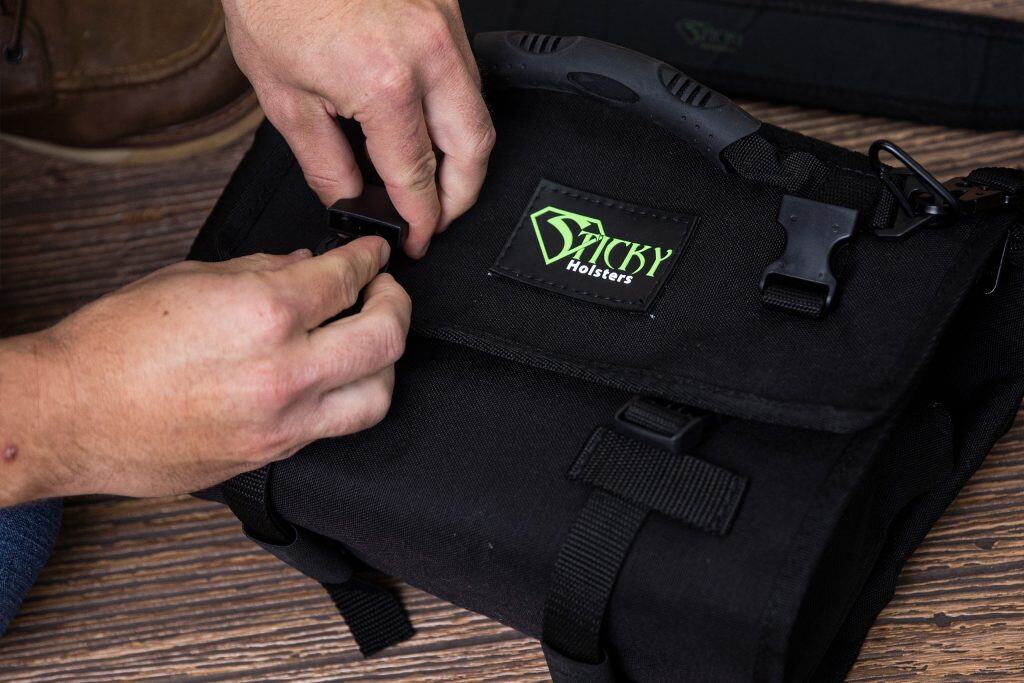
Choosing the right bag is the single most important decision you will make when building an off-body carry system. A standard fashion purse or backpack is not designed for this task and may even be dangerously inadequate. Here are some things you’ll need.
Dedicated Holster Pocket
Your carry bag must have one pocket used exclusively for your holstered firearm. This dedicated space ensures that no other items, keys, pens, cosmetics, can get in the way of your draw or, even worse, work their way into the trigger guard. Keeping the firearm in the same place every time builds crucial muscle memory, so you never have to search for it under stress.
A Quality Holster
A firearm should never be placed loose in a bag. It must be inside a quality holster that completely covers the trigger guard. This is a critical safety feature, as it prevents anything from unintentionally discharging the firearm. A Sticky Holster is an excellent solution, as its simple, form-fitting design provides complete trigger protection while its non-slip exterior helps it remain stable inside a dedicated pocket. Plus, you can easily transition to and from off-body carry, if you so choose.
Discreet Appearance
The goal of concealed carry is to be discreet. A bag covered in tactical webbing or firearm company logos advertises that it contains something worth stealing. The best choice is a neutral and bland bag that blends in with your environment and does not draw unwanted attention. A bag with a diversionary design that mimics an everyday item is ideal for maintaining a low profile.
Securely Positioned Holster
To keep your firearm ready to draw, it should be unable to shift position inside its dedicated pocket, keeping it positioned for a consistent grip and draw angle.
High-Visibility Interior
In a high-stress situation, you need to be able to identify your firearm instantly. A bag with a light-colored interior lining makes it much easier to see your firearm, compared to a standard black interior which can obscure it from view.
Robust Construction
A carry bag must be durable enough to handle the weight of a firearm and accessories without sagging or failing. Look for high-quality zippers that are self-healing and open smoothly without snagging. All hardware, including D-rings and swivels, should be heavy-duty. For security, adjustable straps that are cable-reinforced are preferred, as they are slash-resistant.
Purse? Bag? Pack?
Not all bags are created equal for defensive use. The type of bag you choose will have a direct impact on your accessibility and security.
Viable Option: The Purse, Pack, or Sling Bag
For many, a purpose-built concealment purse or a modern sling bag is the most effective off-body platform. They are designed to be kept on the body and accessible, often with dedicated, quick-access gun compartments. When worn with a robust, cross-body strap, they are difficult to snatch and can be positioned for a consistently fast draw. Their main drawback is that they can be a common target for theft.
Viable Option: The Briefcase or Messenger Bag
In a professional or formal setting, a briefcase or messenger bag can be an extremely discreet carry option. It blends in perfectly with the environment and offers ample space for a full-size firearm and other essentials. However, this platform generally offers slower access than a more fixed-in-position purse or sling bag.
Poor Choice (Usually): The Backpack
While excellent for transporting firearms or carrying gear while hiking, a standard backpack is typically a poor choice for defensive carry. Its position on your back generally makes it the slowest and most cumbersome platform from which to draw a firearm, as it almost always requires you to remove the pack first. This delay is too significant for many potential self-defense scenarios.
Best Practices for Safe Operation
The right gear is only half the equation. Safe and effective off-body carry depends on your personal discipline and technique.
Maintain Positive Control
Your carry bag is not a piece of luggage; it is an extension of your holster. It cannot be left unattended for any reason. When in public, wear your bag with a strap across your body to make it harder to snatch. If you must set the bag down, such as when sitting at a restaurant, we still recommend that you don’t. Avoid those situations if you truly cannot wear the bag in them. Or, remove your Sticky holster from inside the bag beforehand and carry your gun concealed on your body (wardrobe permitting).
The Sticky Holsters Solution
A quality holster inside the bag is the most critical safety component. A Sticky Holster perfectly fulfills the non-negotiable rule of completely covering the trigger guard, preventing any foreign objects from causing a discharge. Its clipless, non-slip design also offers unique versatility. You can seamlessly move gun and Sticky Holster together into your bag’s dedicated compartment when your attire changes. This allows you to carry on- or off-body as the situation requires. For bags that feature the hook and loop lining, our Sticky Travel Mount Adapter allows you to attach our Sticky Travel Mount and firearm securely inside the compartment.
Carry with Intention and Confidence
Off-body carry is a practical solution to real-world challenges, but it’s one that must be approached with intention and discipline. It is a deliberate system that trades the inherent security of on-body carry for versatility, and that trade demands an attention to detail, discipline, and personal awareness.
Regardless of your choice of on- or off-body carry, the foundation of any safe carry method is a quality holster. Sticky Holsters are designed to be the versatile, safe, and simple core of your carry system. Our innovative, clipless design provides complete trigger guard protection and allows you to seamlessly transition your firearm from your waistband to your carry bag without compromising on safety. Whether you need a reliable solution for your dedicated carry purse or a versatile holster for multiple platforms, Sticky Holsters provides the security and flexibility you need.
Build your safe and versatile carry system today. Find the perfect Sticky Holster for your gun and start carrying with confidence!